Doohers and Shakers: Barry Frey
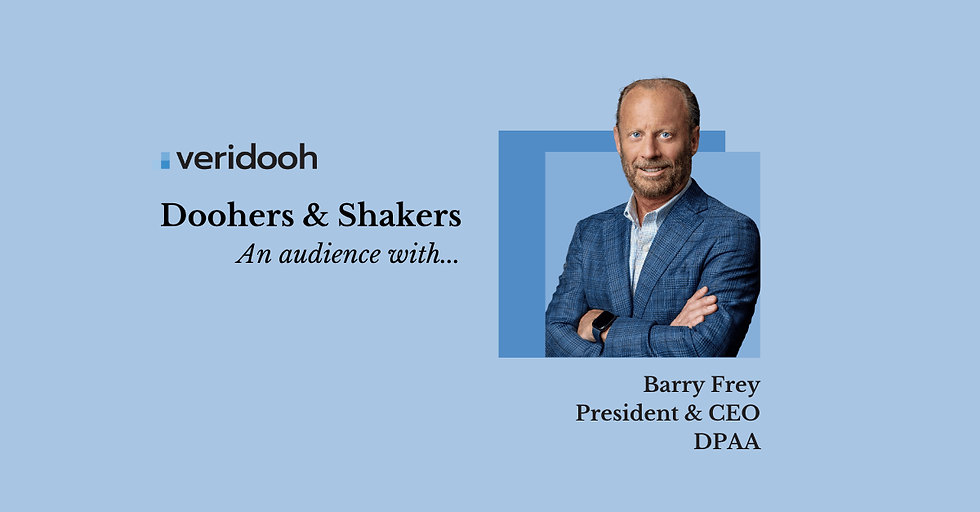
The latest guest in our long-form interview series, Doohers and Shakers, is Barry Frey, President and CEO of DPAA, the global trade and marketing association for the digital out-of-home industry. Barry has led DPAA for over 13 years, championing the medium's evolution from static signage into a data-driven, programmatic channel. Under his leadership, the association has grown its membership and helped establish the standards that support programmatic buying, location data and mobile integration across the ecosystem.
Before DPAA, Barry spent more than two decades building advertising businesses across television, digital and emerging platforms. At Cablevision, he oversaw the shift to digital ad sales and built advanced TV products including addressable and interactive advertising. He also led media programmes at the NBA and spent a decade in international sales and new business development at USA Networks. We hope you enjoy the read!
You've led DPAA for over 13 years, growing it from a domestic trade group into the global association for digital out-of-home. What does the CEO remit actually cover day to day, and how has the scope of DPAA's mission shifted since you took the role in 2013?
Has it already been 13 years?! When I started, we had 22 member companies and now we have 239 in every continent…well except for Antarctica as the penguins don’t look at advertising, only icebergs! We have certainly become a more global organization (or organisation, with an s, as our London office writes it). We have of course navigated challenges like the pandemic, but also great opportunities that have brought so much creative and technological innovation. Yet when all is said and done, what doesn’t change is the mission of growing our industry, the companies that drive it, and the careers of the people figuring out what the next 20 years will bring. To do so, we remain laser-focused on showcasing the unique value, the real connections, and the measurable business outcomes that DOOH offers brands and agencies.
What's the most rewarding part of leading DPAA at this stage of the industry's growth?
I’ll give you two answers to this, and because I’m in marketing, you won’t be surprised that both have weaved their way into our overall brand strategy for DPAA.
One, we launched a podcast earlier this year called Launchpad of Innovation, and I love hearing about all of the innovative ways our members and brands are using everything from dynamic ad content and insertion to AI for making buying and planning and measurement more efficient and accurate. All that in addition to how we are now not only verifying commercial activity but indicating strong business outcomes!
Secondly, the theme for this year’s Summit is Real Connections. The connections we make among members, non-members, brands, agencies, and human beings make it all worthwhile.
You created the Video Everywhere Summit and Campaign to reframe digital out-of-home as part of the integrated video ecosystem alongside mobile, CTV and digital display. Why did that framing matter when you launched it, and how has the case for "video everywhere" changed as CTV and mobile have evolved in their own right?
Consumers and brands all agree that video is the most powerful form of advertising and communication. Video is everywhere and now outside the home! Digital screens that can be bought programmatically, creative that can change dynamically for more contextually-relevant content on each piece of inventory, 3D and AR-enabled ads from Times Square to Piccadilly plus trains, planes, now autos plus gyms, office buildings gas stations, cinema, retail and more.
When you’re buying digital video, it doesn’t make sense to exclude DOOH. And as CTV and mobile – and social video – have evolved, we are seeing more agencies and brands invest in these mediums alongside DOOH, and getting an extra lift in ROI, so it’s definitely not an either/or.
This year's Video Everywhere Summit theme is Real Connections, built on the idea that the more connected our world becomes, the more valuable real-world connections become. What does that theme mean to you, and why is it the right message for the industry to hear in 2026?
I’ve been doing this a long time, so it’s so interesting to me to see how the industry has come full circle. We went from being in real life (IRL) all the time – at conferences, business lunches, meetings, golf outings – to being stuck behind our devices and at our desks.
Ask any young person who came of age and/or started their careers during COVID … maybe their only jobs were working from home, with no real world office to go to … and now are facing all of the disruption promised by AI. They are feeling and behaving like humans have since my career began - needing to, demanding to, be IRL more, put down the phones, and interact and share the same physical spaces with their peers.
And there is abundant trust and authenticity when you are a one to many medium connecting in real life! Every consumer is the same way, and if brands want to successfully reach these younger Millennials, Gen Zers and Gen Alphas, out of home is a must.
You spent years building addressable advertising and advanced platform sales at Cablevision before making DOOH your focus. What from that cable and television career translated most directly into how you think about digital out-of-home today?
Nothing happens in a vacuum, and the best results of any campaign happen when you think first about what the brands and agencies want, how you can provide value to them, and then deliver.
When Cablevision was pioneering interactivity, addressability, branded channels, and measurement based on first-party data, I saw first hand how impactful innovation can be, and how much success can be brought to clients once they understand what’s possible.
All of my career from building cable TV channels to digital to mobile to sports innovation to omnichannel and global I have learned the ways and means to overcome inertia and bring new important media products to market.
Under your leadership, DPAA has championed standards for mobile integration, location data and programmatic buying across the OOH ecosystem. Where is the industry still furthest behind on establishing the kind of common standards that let DOOH scale the way digital has?
Well common standards do present challenges but what we’re really focused on is showcasing the delivery of outcomes up and down the marketing funnel. KPI’s ROI, ROAS from branding and reach down to site, store visits and product sales are proving the medium’s value.
Today, agencies and brands rely on media owner proof of play reports to know whether their campaigns got delivered. Why do you think it’s important for the OOH industry to evolve and provide independent verification which is independently collected without the use of media owner proof of play data?
Third party verification shows that no one is marking their own homework. It generates trust and accountability bringing more confidence in the medium.
What foundational shifts would be required for the OOH industry to turbo charge its growth?
We meet with hundreds of brand and senior agency leaders a year and introduce them to our members. We need this to aggressively continue, that is presenting to leaders before media silos are established. At our 24 DPAA Member Meetings a year, we educate our members how to understand all media and marketing and how to succeed at generating heretofore digital, mobile, online video and TV budgets.
What do you see as the biggest trends and technological advancements shaping the future of OOH over the next 5 years?
We will see more M&A activity, more backroom use of AI for busy work, better marketing and sales skills in the industry.
What important truth about OOH advertising do very few people agree with you on?
Well over a career of building media companies across all media and countries there are basic principles plus tried and true methods that succeed. At first people are comfortable staying in the lane of what they know, but by being curious and expanding our thinking and skills, we can build this medium to its rightful share of the advertising pie.


Comments